IN PROGRESS
French Theory Made in USA. Volume II of The Intellectual World War: Marxism versus the Imperial Theory Industry. New York: Monthly Review Press, forthcoming in 2027.
Radical Theory’s Infantile Disorder. Volume III of The Intellectual World War: Marxism versus the Imperial Theory Industry. New York: Monthly Review Press, forthcoming.
With Jennifer Ponce de León. Revolutionizing Aesthetics: Composing a World Beyond Art. New York: Columbia University Press, Series “New Directions in Critical Theory,” forthcoming.
PUBLISHED
Nota bene: excerpts from some of the books listed below are available for download here.
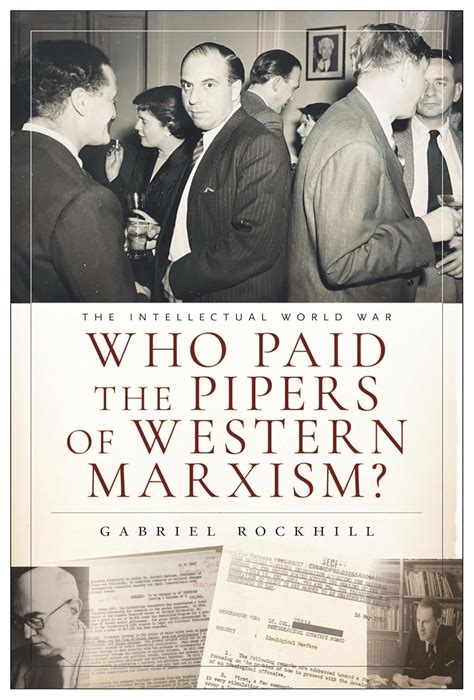
Who Paid the Pipers of Western Marxism? Volume I of The Intellectual World War: Marxism versus the Imperial Theory Industry. New York: Monthly Review Press, 2025. Excerpt translated into Chinese. Forthcoming in French, Chinese, Spanish, Arabic, Turkish, Urdu, Persian, Portuguese.
Who Paid the Pipers of Western Marxism? offers a crash course in the history of imperialist propaganda, as well as in the Marxist method for analyzing culture and ideology. Author Gabriel Rockhill demonstrates the explanatory and transformative superiority of a dialectical and historical materialist approach, while elucidating how the world of ideas is a crucial site of class struggle.
Reviews & Discussions
Science & Society (forthcoming), German Studies Review (forthcoming), Abwärts! (forthcoming), Revolutionary Communist Group, junge Welt (translated in The Left Chapter, reposted on MRonline and SheerPost), Red Ant, nd – neues deutschland (Three Parts), Per un socialismo del secolo XXI, Orinoco Tribune, Le Monde, The Conversation, Critique, Global Research, &&&, Cosmonaut (Second Article), Aftonbladet, e-flux, Platypus Review, Red Spark, Parabol, Kanaan Online (English version), Pittsburgh Review of Books, Dissent, Morning Star, Anti-Capitalist Resistance, Historical Materialism (Four Parts), A Voz do Operário, Jacobin, Klassekampen, Damage, Cosmonaut, Radio Free Asia, CounterCurrents, Marx & Philosophy, Vocal Politics, Counterview, Counterfire, Canarias-semanal, ML Today, Weaponized Information, CounterPunch, Hakim, Yufan Academic Journal, Monthly Review Online
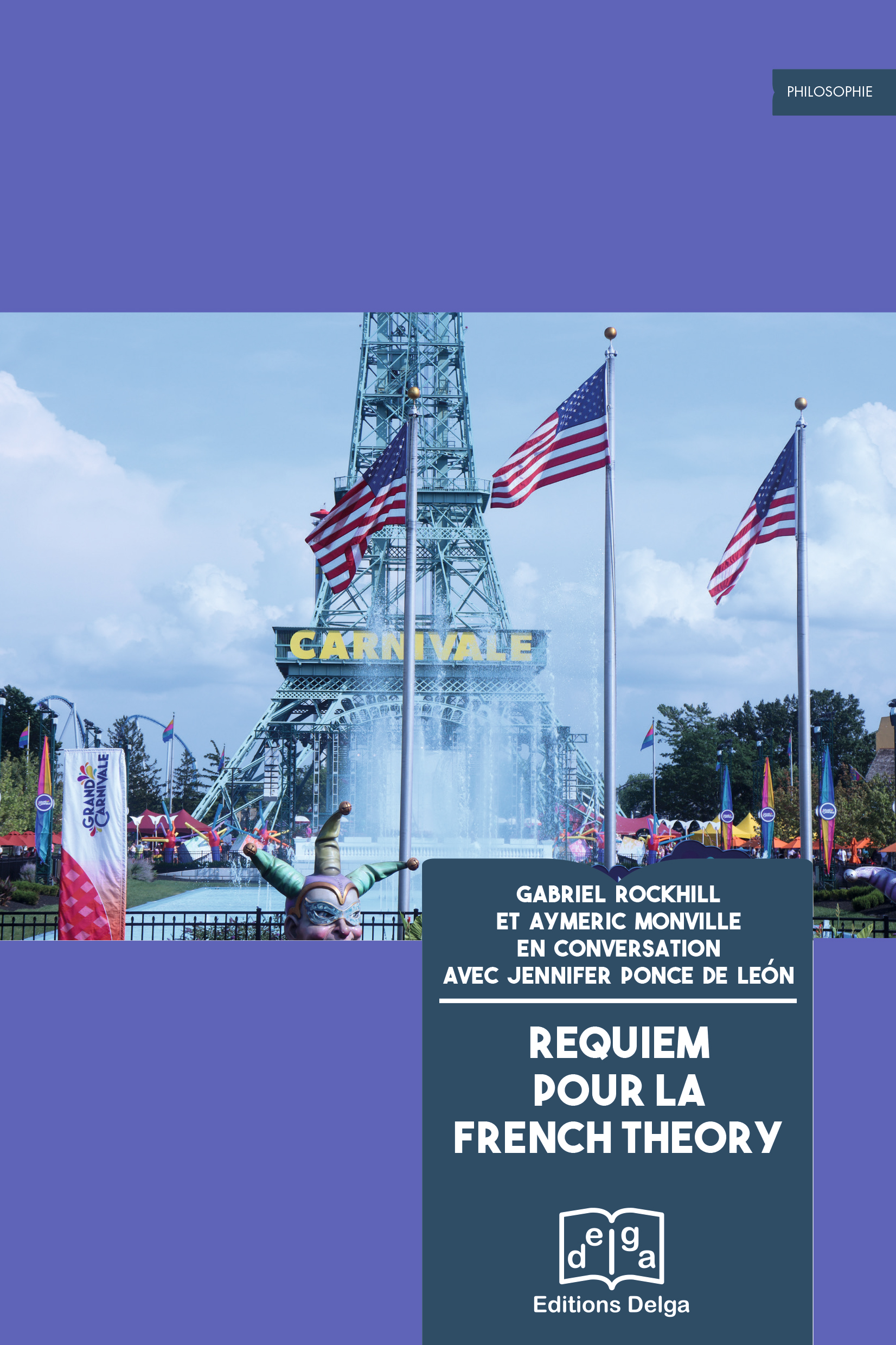
French edition, Gabriel Rockhill et Aymeric Monville, en conversation avec Jennifer Ponce de León, Requiem pour la French Theory, Paris, Éditions Delga, 2024. Translated into English (see below), Hungarian, and Serbian.
French Theory is due for an insider critique, and in Requiem for French Theory, Aymeric Monville and Gabriel Rockhill do just that. Drawing upon decades of studying French philosophy in Paris, they build upon the best Marxist criticisms of postmodernism, while further developing them by situating postmodern theory within the global political economy of knowledge and U.S. driven intellectual imperialism.
Recensions
Le gros rouge qui tâche
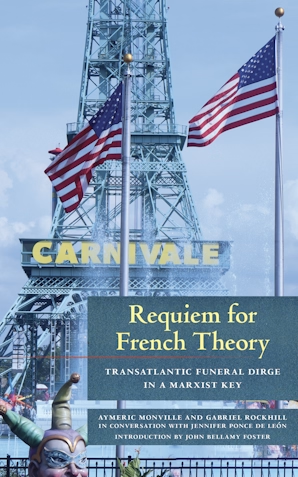
English edition, with an introduction by John Bellamy Foster: Requiem for French Theory: Transatlantic Funeral Dirge in a Marxist Key. New York: Monthly Review Press, 2026.
French Theory is due for an insider critique, and in Requiem for French Theory, Aymeric Monville and Gabriel Rockhill do just that. Drawing upon decades of studying French philosophy in Paris, they build upon the best Marxist criticisms of postmodernism, while further developing them by situating postmodern theory within the global political economy of knowledge and U.S. driven intellectual imperialism.
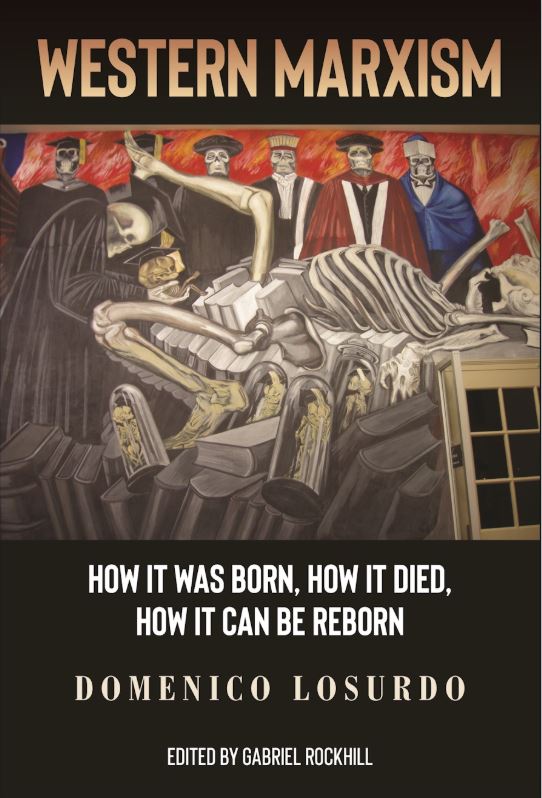
Domenico Losurdo. Western Marxism: How It Was Born, How It Died, How It Can Be Reborn. Ed. Gabriel Rockhill. New York: Monthly Review Press, 2024.
A paradigm-shifting book that provides a trenchant critique of the Western left intelligentsia. It reveals how its dominant ideological orientation—characterized by defeatism, utopianism, and anti-communism—is rooted in the political economy of imperialism. As a complement to the Italian edition of Western Marxism, this first-ever English translation also features the unprecedented publication of a major lecture that demystifies “Western Marxism” and its role in imperialists’ efforts to denigrate the achievements of actually existing socialism.
Reviews
Weaponized Information, Science & Society, Socialist Voice, People’s World, Socialism and Democracy, Spectre, ML Today, Canadian Dimension, Morning Star, Platypus Review, Marx & Philosophy, Journal of Labor and Society, Jacobin, Red Ant, Canarias semanal

French edition. Contre-histoire du temps présent: interrogations intempestives sur la mondialisation, la technologie, la démocratie. Paris: CNRS Éditions, 2017.
Il est communément admis que nous vivrions une ère mondiale où un réseau économique et technologique relie toujours davantage les quatre coins du globe et où la démocratie s’impose comme la condition nécessaire de la vie politique. Pourtant, cette image d’un âge global aussi avancé que civilisé est loin d’aller de soi ou d’être anodine. Enracinée dans un champ de forces sociopolitiques et économiques, elle sert souvent de véhicule clandestin pour des projets redoutables.
Commentaires
ici, la suite, Giovanni Campailla, Revue française de science politique la suite, Pierre-Antoine Chardel, Esprit, la suite, Suzanne Dumouchel, Lectures/Liens socio, la suite, Juliette Monvoisin, Actu Philosophia
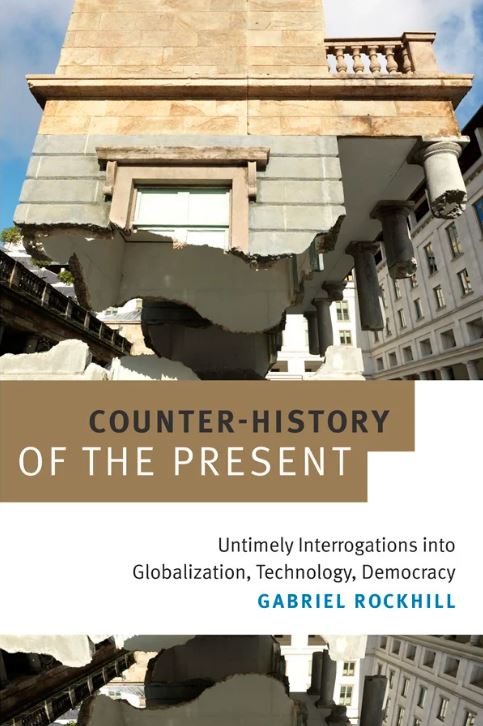
English edition. Counter-History of the Present: Untimely Interrogations into Globalization, Technology, Democracy. Durham, N.C.: Duke University Press, 2017.
Rockhill contests, dismantles, and displaces one of the most widespread understandings of the contemporary world: that we are all living in a democratized and globalized era intimately connected by a single, overarching economic and technological network. Noting how such a narrative fails to account for the experiences of the billions of people who lack economic security, digital access, and real political power, Rockhill interrogates the ways in which this grand narrative has emerged in the same historical, economic, and cultural context as the fervid expansion of neoliberalism.
Endorsements
“A high level polemic attacking the current enthusiasm for the notion of globalization—which Gabriel Rockhill regards as a feature of the political imaginary of our time—Counter-History of the Present will be discussed alongside work by Jameson, Harvey, and Lyotard.” — Andrew Feenberg, author of, The Philosophy of Praxis: Marx, Lukács, and the Frankfurt School
“In an era that, according to Lyotard, was supposed to have seen the end of the grand narratives, a grand narrative is spreading according to which globalization, technological development, and democracy are irresistibly marching forward in step. Gabriel Rockhill refutes this apologetic discourse not simply by appealing to growing social polarization, to shantytowns condemned to backwardness, to the toppling of democratically elected governments established by self-styled champions of democracy. Counter-History of the Present is also an occasion for critical reflection on a series of theoretical categories (beginning with that of history) that dominant contemporary thought employs in an apologetic and often Eurocentric sense. In this way, Rockhill’s book is thus an important reference point for understanding and transforming the present.” — Domenico Losurdo, author of, War and Revolution: Rethinking the Twentieth Century
“Rockhill has written a provocative and highly readable book (indeed, it is even something of a page-turner). […] What is arresting about the book is the aplomb with which Rockhill goes about this task of disclosing the contingency of the present political imaginary. A review of this length cannot do justice to the political force of this critique. But that force, in general terms, lies in the relentless exposure of neoliberalism’s flattening out of ‘time, space, and society.’ If the force of political critique is not to be found in the revelation of a single reality marked out by being ‘now’ – which would be simply to recapitulate the homogenizing and destructive disposition of neoliberal practices of government – it may be located in the recognition of the multiple and contingently related realities of time, space, and social relations. A political theory that is sensitive to the way in which political imaginaries are constituted in and can be challenged through the practices connected across these realities, is likely to have a greater impact on those practices than one that busies itself with the fruitless search for a universal ideal of a democracy whose time can never come, precisely because its place lies outside of time, space, and society… [read more]” — Jason Edwards, Contemporary Political Theory
Interventions in Contemporary Thought: History, Politics, Aesthetics. Edinburgh: Edinburgh University Press, 2016.
Endorsements
“These timely interventions challenge us to rethink the role and influence of scholarly discourse and critique. Gabriel Rockhill has developed a highly original, ‘conjunctural’ approach, which consists in reading the works of the French cultural critics and philosophers that are at the core of his expertise, according to a judgment of relevance and urgency that is part of our own historicity as critics and academics. These sharp readings of Rancière, Derrida, Foucault and Badiou are therefore part of a welcome call to arms to revitalize and politicize Anglo-American cultural scholarship.” — Giuseppina Mecchia, University of Pittsburgh
“Rockhill issues a timely critique of continental philosophy. […] [His] critique of Eurocentrism is refreshingly nuanced and resists falling into an overly facile binary of oppositions—geographic or otherwise—which then demonizes Europe and seems to assume that ‘Europe’ has a stable, unchanging center… [read more]” — Cynthia Nielsen, University of Dallas
Radical History & the Politics of Art. New York: Columbia University Press, Series “New Directions in Critical Theory,” 2014, p. 288.
Endorsements
“In this passionate and rigorous meditation on the politics of art, Gabriel Rockhill argues that neither art nor politics can be founded ontologically. This lack of transcendence brings a saving grace: understood as a historical field of collective negotiations, art recaptures its critical edge, activist agency, and social relevance.” — Jean-Michel Rabaté, University of Pennsylvania
“In this invaluable study, Rockhill vanquishes the myth that either there is some privileged moment—of form, content, or effect—uniting art and politics or there is none.With subtlety and analytic rigor, he demonstrates that the nexus connecting—or separating—art and politics is always bound to the dense weave of social practices located at concrete historical times in specific geographical locales. Along the way, Rockhill provides a scintillating new analysis of the avant-garde and the most acute analysis of Rancière’s aesthetic theory I have come across. Anyone interested in the question of art and politics will want to read this book.” — J. M. Bernstein, New School for Social Research
“Rockhill sets forward a political philosophy of aesthetics that is at once sensuous and pragmatic. This book will make a strong contribution to a practical appreciation of aesthetics and politics.” — Tom Conley, Harvard University
“In this bold and erudite intervention into twentieth-century controversies surrounding art and politics, Rockhill dissolves a whole series of reifications, essentialisms, and other symptoms of magical thinking in a bath of ‘radical historicism.’” — Kristin Ross, New York University
“To isolationist theories and concepts, Rockhill opposes an energetic interventionist strategy that is particularly welcome in the present field of concept-formation.” — Jean-Pierre Cometti, University of Provence
“Elegantly written, informative, and never less than provocative. The result is a radical voice long unheard in the field of theoretical discourse on art.” — Ádám Takács, Eötvös Loránd University Budapest
“Rockhill’s book is a polemic against the various theoretical presuppositions and postures, which fatally misconstrue the relevant factors for assessing the actual agency of aesthetic practices. It is also an assertive defence of the ‘politicity’ of these practices…. [His] book is important because it gives exemplary attention to the factors that a competent approach to this area needs to consider… [read more]” — Alison Ross, Notre Dame Philosophical Review
“One welcomes [an] ambitious, iconoclastic work like Gabriel Rockhill’s Radical History and the Politics of Art… [read more]” — Andrew Weiner, Radical Philosophy
“Rockhill’s ambitious and erudite Radical History and the Politics of Art covers a sizable and variegated terrain… [read more]” — Pavel Lembersky, H-Socialisms
“The basic claim that ties this engaging essay collection together is that past interpreters of the relationship between art and politics err in seeing the relationship in terms of two independent domains that exist prior to the relationship between them… [read more]” — C.R. McCall, Choice
“Radical History is an engagingly written book that is full of insight, and which judiciously and forcefully combines readings of some of the most cited critics on art and politics in the twentieth century. As such, it makes a new, demanding inquiry into the appropriate methodology for rethinking politicized aesthetic practices… [read more]” — Sophie Seita, Modernism/modernity
“Radical History and the Politics of Art invites us to abandon many of the myths upon which debates on art and politics have relied for decades. The book successfully breaks with the binary logic behind the majority of studies on this subject and puts into question the widely accepted theory of aesthetic autonomy. Rockhill’s insightful critique of Jacques Rancière’s thought, his valuable reevaluation of the politics of avant-garde art, and his numerous concrete examples drawn from a variety of artistic traditions and commonly overlooked arts such as architecture, ensure that this work will quickly become a versatile reference. Overall this is a stimulating and forcefully argued book that clears the ground for future scholarship on the social politicity of art… [read more]” — Ioana Vartolomei Pribiag, SubStance
“Rockhill’s project is ambitious and very worth the while in that it forces us to struggle with what we take for granted: the relationship between ‘art’ and ‘politics.’ His work poses quite a challenge… [read more]” — John Randolph LeBlanc, Clio: A Journal of Literature, History, and the Philosophy of History
Logique de l’histoire: Pour une analytique des pratiques philosophiques. Paris: Éditions Hermann, series “Hermann Philosophie,” 2010, p. 534.
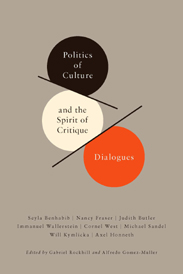
English edition. Co-edited with Alfredo Gomez-Muller, in collaboration with S. Benhabib, N. Fraser, J. Butler, I. Wallerstein, C. West, W. Kymlicka, M. Sandel and A. Honneth: Politics of Culture and the Spirit of Critique: Dialogues. New York: Columbia University Press, Series “New Directions in Critical Theory,” 2011, p. 288.

French edition. Politics of Culture and the Spirit of Critique, with slight modifications: Critique et subversion dans la pensée contemporaine américaine: Dialogues. Paris: Éditions du Félin, 2010, p. 192.

Spanish edition. Politics of Culture and the Spirit of Critique, with slight modifications: La teoría crítica en Norteamérica: Política, ética y actualidad. Medellín: La Carreta Editores, 2008, p. 164.
Co-edited with Pierre-Antoine Chardel: Technologies de contrôle dans la mondialisation: Enjeux politiques, éthiques et esthétiques. Paris: Éditions Kimé, 2009, p. 207.
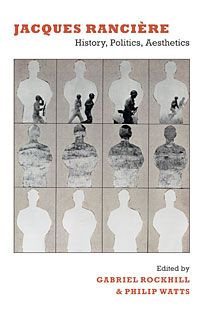
Co-edited with Philip Watts: Jacques Rancière: History, Politics, Aesthetics. Durham, North Carolina: Duke University Press, 2009, p. 368.
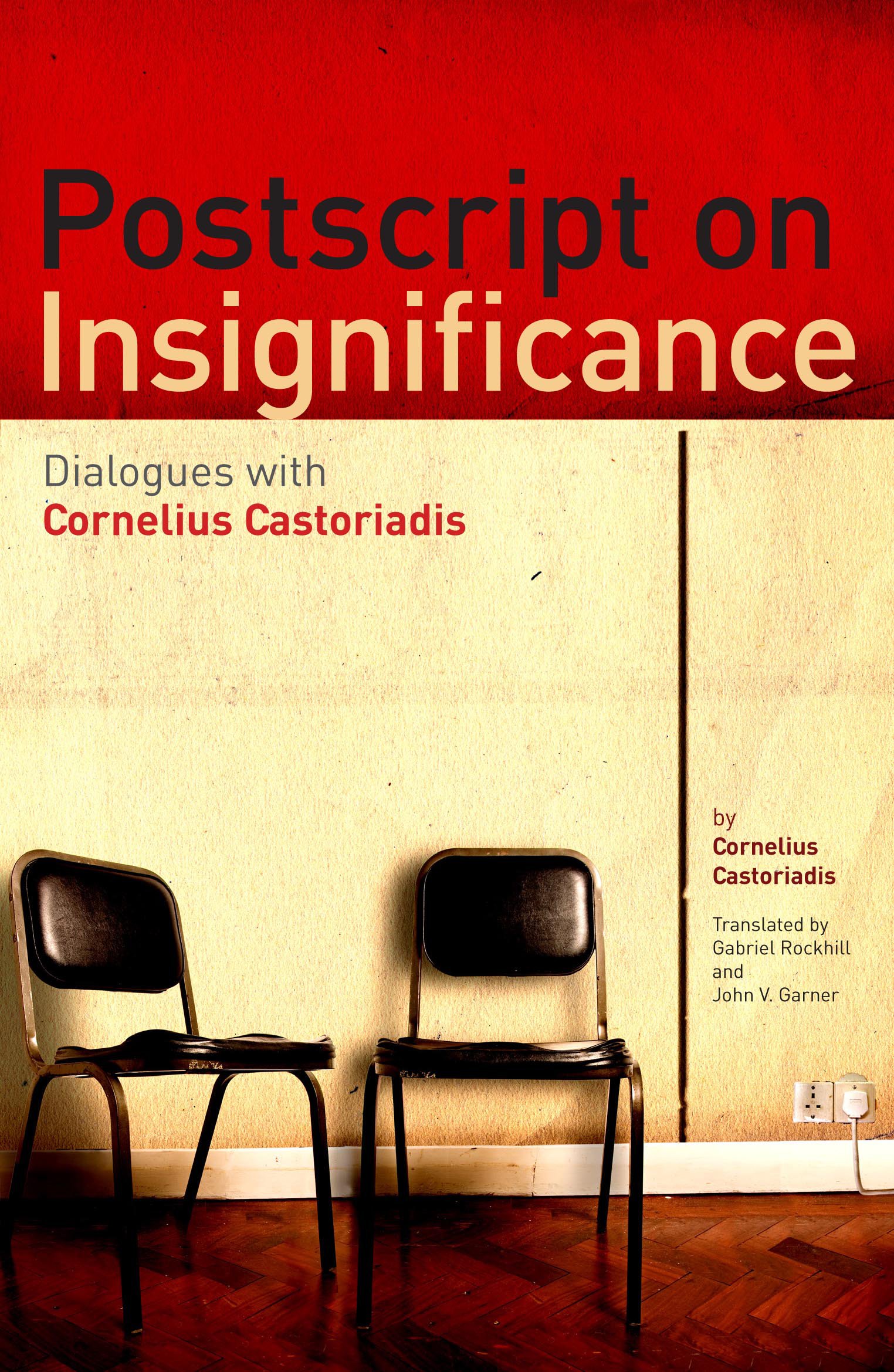
Edited and Co-translated with John V. Garner and the Villanova French Translation Workshop: Cornelius Castoriadis. Postscript on Insignificance: Dialogues with Cornelius Castoriadis. London: Continuum Books, 2011, p. 160.

Edited and Translated: Jacques Rancière. The Politics of Aesthetics. London: Continuum Books, 2004, p. 112.

