Category Archives: Uncategorized

Course on “Why Marx Matters”

See below for information on an upcoming course, which will be both online from 11/22-11/24 (https://criticaltheoryworkshop.com/why-marx-matters-11-22-11-24-19/) and in-person on 11/23 if you are in Philadelphia (https://criticaltheoryworkshop.com/why-marx-matters-11-23-19/).

This seminar will elucidate the fundamental tenets of Marx’s philosophy, as well as their importance for understanding and transforming the contemporary world order. It will begin by explaining key concepts like historical materialism, class struggle, alienation, the labor theory of value, ideology and revolution. It will then briefly discuss a few of the important debates in the deep and broad history of Marxism in order to explore some of the ways that Marx’s work has been interpreted and transformed by subsequent generations. Finally, the course will focus in on what Marxist analysis has to contribute to contemporary debates and struggles by demonstrating how it can help us understand phenomena such as the environmental catastrophe, the increasing social inequality of globalization, the carceral state and its relationship to electoral democracy, the military-industrial-academic complex, institutional racism and gender inequality. Although the course will be directed at a lay audience, it will pedagogically build up its analysis in such a way that it will also serve the interests of those with a working knowledge of Marx and Marxism.

Continue reading

Lecture on the Myth of ’68 Thinkers

I was pleased to have the opportunity to present an abbreviated version of one of my forthcoming articles at the University of Shanghai on October 13, 2019. The title and abstract are below.

The Myth of ’68 Thought: Historical Commodity Fetishism and Ideological Rollback

This paper critically examines the widespread assumption that there is such a profound connection between French theory and the political events of 68 that the former merits the title of ‘68 thought.’ It begins by a materialist analysis of the historical relationship between the most prominent representatives of French theory—ranging from Michel Foucault and Jacques Derrida to Pierre Bourdieu and Jacques Lacan—and the actual political events unfolding at the time. After demonstrating their distance from the major political mobilizations, which often included an overt rejection of them, the paper turns to the larger cultural question of the ways in which the myth of 68 thought was produced, as well as to the issue of its social function in the global theory industry. It is in this light that it proposes an analysis of the historical commodity fetichism around 68, before concluding with a critical assessment of how the presumed radicality of “68 thinkers” serves to police the left border of critique.

Lecture on Liberal Democracy and Fascism on 10/10/19

I’m thrilled to have the opportunity to present my research on a counter-history of liberalism and fascism at this conference at UC Santa Cruz on October 10th and 11th:

70789562_10156774958403892_987375963027275776_o

Panel on Zones of Liberation

I’m excited to have the opportunity to participate in this event organized by Michael Lardner for the Marxist Education Project.

ZonesOfLibertion


Lecture on Soft Power and the Construction of “French Theory”

Click here (or see below) to watch my lecture at the Critical Theory Workshop‘s spring symposium on Counter-History and Theory at the University of Pennsylvania on April 26, 2019, entitled “From Counter-History to Subterranean History: Soft Power and the Construction of ‘French Theory.'” (discussant: Jennifer Ponce de León).

Interviewed by J. Ponce de León for “Philosophy Today”

I was interviewed by Jennifer Ponce de León about my book Counter-History of the Present, and how it relates to genealogy, deconstruction and anticolonial theory. Click here for a link to the interview, and here for a pdf. The title of the interview is “Materialist Deconstruction, Anticolonial Geographies, and the Limits of Genealogy: An Interview on Counter-History of the Present.”

51GyEIiJWHL._SX331_BO1,204,203,200_Abstract
In this wide-ranging interview, Gabriel Rockhill discusses his most recent book, Counter-History of the Present, in the broader context of his research to date on aesthetics, politics and history, as well as its relationship to important interlocutors like Jean-François Lyotard, Michel Foucault, Jacques Rancière, Jacques Derrida, Frantz Fanon and Simone de Beauvoir. He explains the similarities and important differences between genealogy and counter-history, and he elucidates how his work performs a materialist deconstruction that contests the idealist logocentrism operative in purely textualist modes of interpretation. The interview also develops an account of “radical geography” that calls into question culturalist spatial imaginaries, which plague certain forms of decolonial theory that diminish or efface social stratification and class conflict. The discussion thereby contributes to the development of a new model for critical social theory with an internationalist perspective, which seeks to weave these conceptual innovations into a rigorous and radical materialism.

Online Summer Seminar: University of the Commons

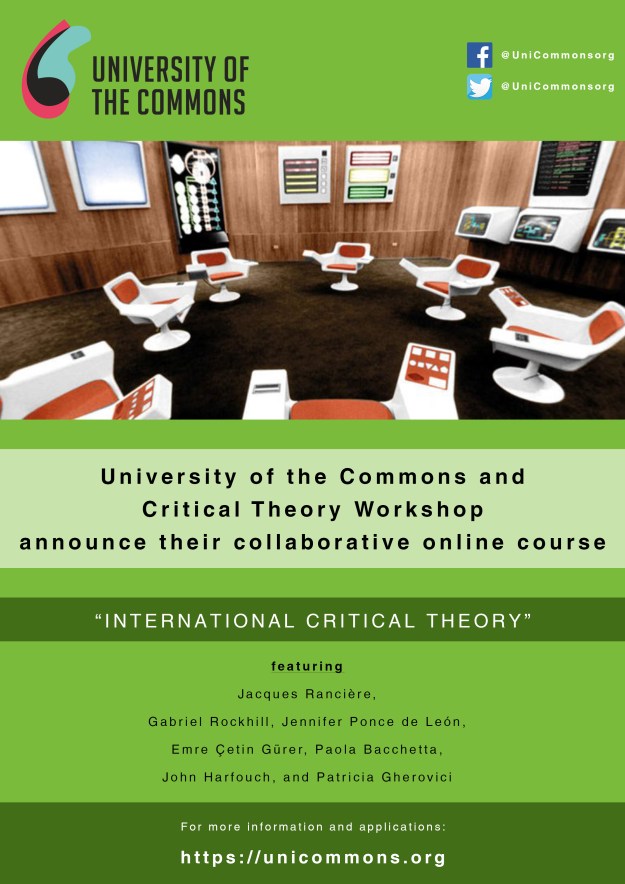
Check out the University of the Commons‘ online summer seminar on “International Critical Theory,” which will run in parallel to the Critical Theory Workshop‘s summer program in Paris. If you’re interested in the topic, click here for all of the details.

afis_01

Online Seminar on “International Critical Theory”

I’m excited to collaborate with Emre Çetin Gürer and the University of the Commons to launch an online seminar in July on “International Critical Theory,” which will run in parallel to the Critical Theory Workshop‘s summer program in Paris. If you’re interested in the topic, click here for all of the details.

cybersyn_control_room-e1559787302472Description
The Critical Theory Workshop, in collaboration with the University of the Commons, is proposing an online seminar that will run in parallel to the July workshop in Paris, extending its work into a global virtual network of scholars while facilitating the participation of those who cannot afford to travel. By combining live streams and recordings of select events in Paris with a series of participatory symposia run by the facilitator, the course seeks to put global communications technology in the service of an ecological and widely accessible format for international education. Continue reading

Article in “State of Nature” on Yellow Vests

I was pleased to have the opportunity to contribute to a series in State of Nature on the Yellow Vests. All articles in the series were tasked with responding to the question: “What is the significance of the Gilets Jaunes movement?” Click here to read my reply (also copied below).

GiletjauneswebThe Gilets Jaunes are significant for at least four reasons. First and foremost, they are a grassroots social movement that has arisen in reaction to the ongoing onslaught of global capitalism. The fact that this movement emerged outside of the representational structures that generally serve to support this system – including the professional political parties of parliamentary pseudo-democracy and the bureaucratised unions – indicates the extent to which these structures themselves, with few exceptions, have not been able to successfully mobilise and empower the working classes, but have instead managed their discontent. Continue reading

Interviewed on KPFA on Articles on Yellow Vests

I was honored to be invited by C.S. Soong on KPFA’s “Against the Grain” to discuss my publications on the Yellow Vests. Click here to listen to or download the episode, which can also be listened to here:


Here is the description of the interview online:

Yellow Vest Realities and Reactions

The Yellow Vests have shaken the French political establishment to its core. What are the protesters’ grievances, and how has the uprising been viewed by intellectuals on the left? Gabriel Rockhill describes and assesses the Yellow Vests movement, the Macron regime’s reaction to it, and the French intelligentsia’s opinions of it.

Gabriel Rockhill, “The Failure of the French Intelligentsia? Intellectuals and Uprisings in the Case of the Yellow Vests” The Philosophical Salon

Gabriel Rockhill, “Spectacular Violence as a Weapon of War Against the Yellow Vests” CounterPunch

Étienne Dolet and the Radical Education Department, “Ten Lessons from the Yellow Vests” It’s Going Down