A special thanks to Κώστας Μπουγιούκος and Γιώργος Μιχαηλίδης for the Greek translation and presentation of my article “The CIA Reads French Theory,” originally published in the L.A. Review of Books’ “The Philosophical Salon.” Click here to read the translation and presentation.
Author Archives: RED
RED Launched: a New Political Organization for Radical Direct Action Education
I am very pleased to have launched, with a number of energetic collaborators, the Radical Education Department. RED is an autonomous collective dedicated to the construction of a radical internationalist Left through the training and federation of its cultural warriors. The full scope of RED’s initial project is outlined here in the “RED Alert Manifesto.” Our primary activities at this point include:
- Direct action education, meaning both direct action as education and education regarding the powerful history of direct action.
- The constitution of a network of invested cultural warriors and educators, who share the conviction that antifa resistance needs to be accompanied by the positive project of forging new practices of radical education for collective world transformation.
- The development of tactics of guerrilla education, which brings radical pedagogical practice to areas where it might be least expected, ranging from corporate universities to the streets of consumerism.
- The establishment of an underfunded, left-wing research collaborative as a counter-weight to all of the over-funded, reactionary ‘think-tanks’ and their academic extensions.
- The injection of a hardy dose of hard left ideas into the ‘public sphere’ by working as public intellectuals, artists and writers.
- The centralization of resources and the development of strategies for fellow travelers around the world.
We welcome collaborators and initiatives. Click here to contact us. If you are interested in getting involved and/or staying up on our activities, please follow our webpage here and like us here on FB. Stay tuned for further updates!

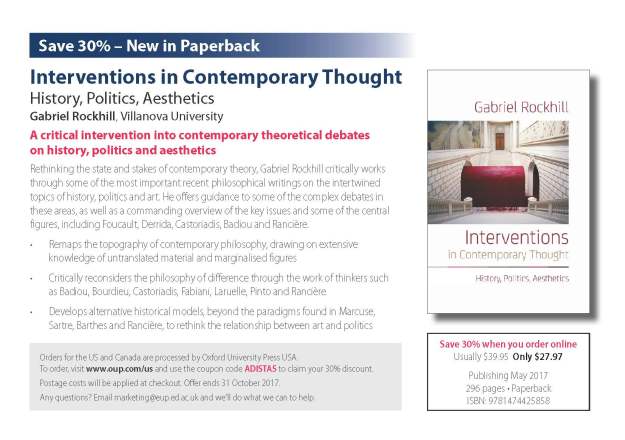
Paperback Release of “Interventions”
I am very pleased to announce the publication of the paperback edition of Interventions in Contemporary Thought: History, Politics, Aesthetics (Edinburgh: Edinburgh University Press, 2017). Edinburgh UP is offering 30% off the new edition: click here, and then enter the coupon code ADISTAS.
Lecture at the MCSI Summer Institute
I will be participating in the Modern and Contemporary Studies Initiative at Penn State and presenting a lecture on “Knowledge/Power behind the Scenes” at their inaugural Summer Institute. Click here for the program.
Conférence à Paris le 9 juin 2017
Je vais présenter une conférence intitulée “Comment sortir de la prison du temps présent?” dans le cadre du colloque “Économies de l’existence” à l’École Normale Supérieur et à NYU à Paris.

Debate on France 24
A special thanks to France 24 for inviting me to participate in this debate on Comey & Trump:
Review of “Radical History & the Politics of Art”
John Randolph LeBlanc published a review of Radical History & the Politics of Art in Clio: A Journal of Literature, History, and the Philosophy of History 45:2 (spring 2016): 234-238.
Keynote Northwestern 6/2/17
I will be presenting the keynote lecture at the conference on “Resistance, Radicalisms and Aesthetics,” which has been organized by the graduate students in the Department of French and Italian at Northwestern University. Click here for the full program. An abstract of my lecture is below.
The Political Plurivocity of Aesthetics:
Equality and Empire in Whitman’s Poetic Revolution
This lecture seeks to demonstrate the political plurivocity of aesthetic practice, meaning the extent to which artistic work is the site of multiple and often conflicting political investments, be it at the level of production, circulation or reception. This plurivocity calls into question the very widespread reduction of individual artists or their works to single political positions, an approach that tends to define the task of the critic as one of drawing up binary lists of ‘good’ and ‘bad’ political art. In critically dismantling this univocal politics of aesthetics—as well as the unidimensional hermeneutics and the moralizing dichotomies that it favors—it is not sufficient, however, to simply point to the complexities of aesthetic practices as multifaceted social phenomena. It is necessary to develop a multidimensional analysis of these practices that is capable of providing a nuanced map of their political plurivocity, precisely in order to be able to intervene more effectively in it.
As a specific instance of this struggle, the paper turns to the work of Walt Whitman and his proposed poetic revolution in New World literature. It elucidates his provocative account—which resonates strongly with the work of figures like Schiller, Hugo and the early Marx—of aesthetic revolution as the necessary cultural supplement to a purely political revolution, explicating how art and literature compose a people by simultaneously depicting and forging its culture, norms, affects and personalities. It then situates his project in the historical nexus it calls its own, detailing Whitman’s unique contribution to the revisionist historiography of democratic theodicy, and more specifically American manifest destiny. Finally, it explores the diverse ways in which the purportedly egalitarian poet of a new world literature, at least in certain of his writings, subjected other people—particularly the enslaved and the colonized—to a brutal, imperial process of decomposition. It thereby foregrounds the multiple dimensions of politics operative in his work and the extent to which the struggle over its reception and interpretation is part and parcel of its social politicity.
Program for the CTW/ATC 2017 in Paris
The provisory program for the Critical Theory Workshop / Atelier de Théorie Critique, which is an intensive research collaborative that I run in Paris over the summer, has been set. Click here to read in full. The list of invited guests includes Marielle Macé, Patrice Maniglier, Peter Skafish, Philippe Corcuff, Sophie Wahnich, Alice Canabate, Marie Goupy, Jennifer Ponce de León, Jean-François Bayart, Andrew Feenberg, Bernard Stiegler and Özgür Gürsoy. Participants in this year’s workshop come from approximately 12 different disciplines and 15 cultural backgrounds. Click here to read their profiles.