Category Archives: Uncategorized

Traduction française de mon article sur la “démocratie” américaine

Réseau international a publié une traduction française de mon article, “The U.S. Is Not a Democracy; It Never Was” (CounterPunch, le 13 décembre, 2017). Cliquez ici pour la lire.

Extrait de “Les États-Unis ne sont pas une démocratie, ils ne l’ont jamais été“:

56ccda82c46188b8098b4601-1728x800_cL’une des croyances les plus fermes en ce qui concerne les États-Unis est qu’il s’agit d’une démocratie. Chaque fois que cette conviction fait l’objet d’un léger fléchissement, c’est presque toujours pour signaler des exceptions préjudiciables aux valeurs ou aux principes fondamentaux américains. Par exemple, les détracteurs en herbe déplorent souvent une « perte de démocratie » due à l’élection de clowns autocrates, à des mesures draconiennes de l’État, à la révélation d’incroyables malversations ou corruption, à des interventions étrangères meurtrières ou à d’autres activités considérées comme des exceptions antidémocratiques. Il en va de même pour ceux dont la démarche critique consiste à toujours juxtaposer les actions du gouvernement américain avec ses principes fondateurs, à mettre en évidence la contradiction entre les deux et à placer clairement un espoir dans sa possible résolution.  Continue reading

Review of “Counter-History of the Present”

Jason Edwards published a detailed review of Counter-History of the Present: Untimely Interrogations into Globalization, Technology, Democracy. It appeared in Contemporary Political Theory and can be read here.

51GyEIiJWHL._SX331_BO1,204,203,200_Excerpt: “Rockhill has written a provocative and highly readable book (indeed, it is even something of a page-turner). […] What is arresting about the book is the aplomb with which Rockhill goes about this task of disclosing the contingency of the present political imaginary. A review of this length cannot do justice to the political force of this critique. But that force, in general terms, lies in the relentless exposure of neoliberalism’s flattening out of ‘time, space, and society.’ If the force of political critique is not to be found in the revelation of a single reality marked out by being ‘now’ – which would be simply to recapitulate the homogenizing and destructive disposition of neoliberal practices of government – it may be located in the recognition of the multiple and contingently related realities of time, space, and social relations. A political theory that is sensitive to the way in which political imaginaries are constituted in and can be challenged through the practices connected across these realities, is likely to have a greater impact on those practices than one that busies itself with the fruitless search for a universal ideal of a democracy whose time can never come, precisely because its place lies outside of time, space, and society. […read more]”

Whitman Article Published

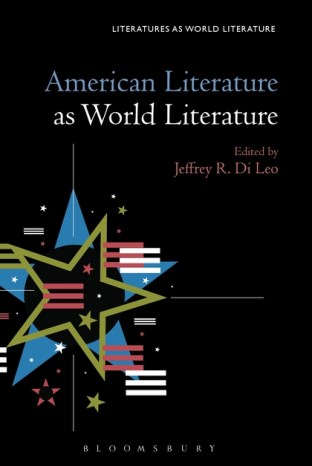
My article, “Whitman’s Polyvocal Poetic Revolution: Equality and Empire in New World Literature,” was just published in American Literature as World Literature. Ed. Jeffrey R. Di Leo (London: Bloomsbury, 2018). Click here for a link to the book. The opening paragraph, which outlines the argument, can be found below.

9781501332302“This study seeks to demonstrate the political plurivocity of aesthetics via an exploration of the motley dimensions of Walt Whitman’s proposed poetic revolution. In resisting the widespread reduction of individual writers or works of art to single political positions (or a set of distinct, sequential views, as when an artist changes political orientations over time), it highlights the multiple dimensions of politicity operative in artwork. It begins, then, with an elucidation of Whitman’s provocative account of aesthetic revolution as the necessary cultural supplement to a purely political revolution, explicating how art and literature compose a people by simultaneously depicting and forging its culture, norms, affects and personalities. It then situates his project in the historical nexus it calls its own, detailing Whitman’s unique contribution to the revisionist historiography of democratic theodicy, and more specifically American manifest destiny. Finally, it explores the diverse ways in which the poet of new world literature, at least in certain of his writings, subjected other people—particularly the enslaved and the colonized—to a brutal process of decomposition.”

Persian Translation of Democracy Article

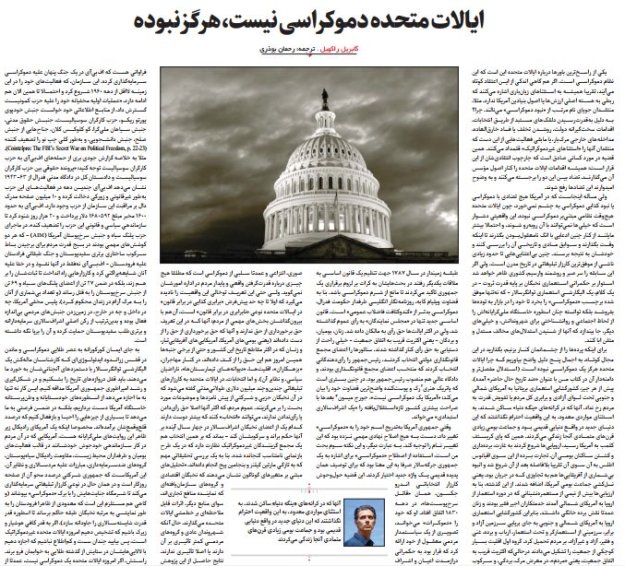
DRtl5cRXcAAkzco.jpg-largeA special thanks to Rahman Bouzari and Shargh Newspaper for the Persian translation of my article “The U.S. is Not a Democracy, It Never Was.” Click here to read the Persian version.

Artículo en español

democracy2
Haga clic aquí para leer una traducción al español de mi artículo “Estados Unidos no es una democracia, nunca lo fue” (CounterPunch 12/13/17: “The U.S. is Not a Democracy, It Never Was“).

Article in CounterPunch: U.S. Has Never Been a Democracy

My article, “The U.S. is Not a Democracy, It Never Was,” was just published in CounterPunch. It was developed as part of the research and activism activities of the Radical Education Department (RED). Click here to read it.

Excerpt:
Rather than blindly believing in a golden age of democracy in order to remain at all costs within the gilded cage of an ideology produced specifically for us by the well-paid spin-doctors of a plutocratic oligarchy, we should unlock the gates of history and meticulously Screen-Shot-2017-12-04-at-8.55.14-PM-768x507scrutinize the founding and evolution of the American imperial republic. This will not only allow us to take leave of its jingoist and self-congratulatory origin myths, but it will also provide us with the opportunity to resuscitate and reactivate so much of what they have sought to obliterate. In particular, there is a radical America just below the surface of these nationalist narratives, an America in which the population autonomously organizes itself in indigenous and ecological activism, black radical resistance, anti-capitalist mobilization, anti-patriarchal struggles, and so forth. It is this America that the corporate republic has sought to eradicate, while simultaneously investing in an expansive public relations campaign to cover over its crimes with the fig leaf of “democracy” (which has sometimes required integrating a few token individuals, who appear to be from below, into the elite ruling class in order to perpetuate the all-powerful myth of meritocracy). If we are astute and perspicacious enough to recognize that the U.S. is undemocratic today, let us not be so indolent or ill-informed that we let ourselves be lulled to sleep by lullabies praising its halcyon past. Indeed, if the United States is not a democracy today, it is in large part due to the fact that it never was one. Far from being a pessimistic conclusion, however, it is precisely by cracking open the hard shell of ideological encasement that we can tap into the radical forces that have been suppressed by it. These forces—not those that have been deployed to destroy them—should be the ultimate source of our pride in the power of the people […read more].

Conférence et lancement du séminaire sur la socio-philosophie

Pour lancer notre séminaire à l’Ecole des Hautes Etudes en Sciences Sociales (voir les détails ci-dessous ou cliquer ici), je fais une intervention aujourd’hui le 17 novembre intitulée “Socio-philosophie et contre-histoire du temps présent”.

Socio-philosophie du temps présent. Enjeux épistémologiques, méthodologiques et critiques

  • Pierre-Antoine Chardel, professeur à l’Institut Mines-Télécom (TH) ( IIAC-CEM )Cet enseignant est référent pour cette UE
  • Valérie Charolles, conseillère référendaire à la Cour des comptes ( IIAC-CEM )
  • Gabriel Rockhill, professeur à l’Université Villanova (USA) ( Hors EHESS )

Ce séminaire a pour vocation de réfléchir aux conditions de possibilité de l’émergence d’une socio-philosophie du temps présent. Il prendra la démocratie et la technologie comme premiers champs de questionnement pour justifier cette articulation entre philosophie et sociologie. La conviction qui anime cette ambition de délimiter un tel geste, à la fois pratique et théorique, renvoie d’une part au fait que les complexités du monde actuel nous incitent à interroger la manière dont nous pouvons philosophiquement nous en saisir tout en échappant aux tentations de leur mise en système. D’autre part, la plupart des crises auxquelles nous nous heurtons (sur le plan économique, politique ou écologique) nous imposent de réfléchir aux enjeux épistémologiques, éthiques et méthodologiques de nos pratiques théoriques en vue de questionner leurs fondements, leurs présupposés, mais également leur ethnocentrisme sous-jacent.

Nous assumerons dans cette perspective le fait que la philosophie doit, plus que jamais, se pratiquer en se tenant au plus près des affaires humaines, en tissant de la sorte un dialogue aussi riche que possible avec les sciences sociales (la socio-anthropologie, la socio-histoire et la socio-économie plus particulièrement). Il s’agira enfin, dans le cours de nos séances, de nous pencher sur certaines grandes catégories de pensée dont nous avons principalement héritées d’une philosophie dite « gréco-occidentale », en essayant de les analyser à nouveaux frais en vue d’assumer une pratique théorique immanente et plurielle qui puisse s’attacher à forger des cartographies alternatives dans notre compréhension du monde au travers de ses dimensions sociales, technologiques, matérielles et symboliques. Car il y a toujours plusieurs forces à l’oeuvre dans ce que l’on désigne par les termes de « société du spectacle », « économie néolibérale », « société de l’information », ou de démocratie dite « représentative ». Compte-tenu de la pluralité des facteurs qui interviennent dans la construction de nos univers intimes, économiques, sociaux, culturels et symboliques, force est de reconnaître que « le monde contemporain » est constitutivement multidimensionnel, porté par des régimes d’énonciation hétérogènes : il appelle l’élaboration d’une pensée critique du temps présent, qui se confronte au plan épistémologique, méthodologique et éthique à ces différences.

Continue reading

Call for Applications: Critical Theory Workshop in Paris, Summer 2018

Click here for the 2018 call for applications to the Critical Theory Workshop / Atelier de Théorie Critique. The 2018 Workshop, directed by Gabriel Rockhill and supported by Villanova University’s Doctoral Program in Philosophy, will take place from June 11-29 at the EHESS in central Paris. It is open to graduate students and faculty, as well as advanced undergraduates, independent researchers, writers and artists.

Cover_ZooProjectTunisianRevolution13-e1348415033280

The 2018 Workshop will be comprised of three interlocking components:
• “Débats”: invited speakers debate on a common theme or question.
• “Rencontres”: intellectuals are invited to participate in public interviews on their work.
• “Groupes de travail”: the participants present and workshop their own research.

The overall objective is to bring together a diverse panoply of thinkers from different horizons in order to cultivate productive debates around topical issues. Invited guests for 2018 thus far include Seloua Luste Boulbina, Eric Hazan, Jennifer Ponce de León and Delia Popa.

Lecture: “Making a Specter Out of Marx”

I was very pleased to participate in the conference “Critique in German Philosophy” at Depaul University in Chicago from November 9th to 11th. Click here for the program. An abstract of my paper, entitled “Making a Specter Out of Marx: The Reformist Agenda of Contemporary Critical Theory,” can be found below.

Слипачук Артем

Krzysztof Bednarski, “The Ghost Is Wandering,” 2013

Abstract
This paper examines the demise of Marxism in contemporary critical theory. It begins by foregrounding the central importance of Marxist critique to the early Frankfurt School, which was explicitly dedicated to mobilizing theoretical tools for social emancipation from capitalism. By marshaling and reinvigorating the reflexive strategy of the first generation of critical theorists, which consists in resituating subjects and knowledge claims in the objective social world, it explores the need for a social critique of contemporary ‘critical reason,’ and more specifically of the ways in which the second and third generations of the Frankfurt School have made a specter out of Marx. It is in this light that it examines whether the combined decrescendo of certain Marxist discourses within the academy and the ear-piercing crescendo of imperial neoliberalism has many self-proclaimed critical theorists working at counter-purposes: paying rhetorical lip service to a vague Marxian heritage while defanging its critical bite and realigning ‘critique’ on a reformist agenda within the dominant system of capitalism and corporate political rule under liberalism. The taming of critical theory in the age of neoliberal hegemony leads, in conclusion, to a broader conjunctural question: can critique be radicalized in order to shake it out of its neoliberal academic slumbers?


TV Debate on France 24: State of Emergency

I participated in a discussion of France’s new state of emergency measures on “The Debate” on France 24: “The Security of France: Has the State of Emergency Become Permanent?” (October 31, 2017). Click here to watch the video.

23120150_907787912712724_3802006011886462767_o